The Super Bowl remains marketing’s most visible Hail Mary. It delivers massive reach, cultural relevance, and a guaranteed national audience in a single moment. Few other platforms can concentrate attention at that scale, that quickly.
In 2026, brands approached the game with more sophistication than ever. Ads were released online before kickoff. Teasers rolled out weeks in advance. Social cutdowns appeared within minutes of airing. The industry has clearly learned that a Super Bowl spot cannot exist in isolation.
Yet during our Super Bowl conversation with YouGov, something more strategic emerged from the data. While brands are getting better at extending the moment, far fewer are structuring what happens after the moment.
The Super Bowl still does what it has always done exceptionally well. It creates attention. Awareness spikes. Search lifts. Social chatter accelerates. For a few hours, brands feel culturally omnipresent.
What it does not automatically create is sustained preference.
That is where the gap begins.
Attention Is Divided, Not Guaranteed
Even how audiences experienced the game reflects a shift.
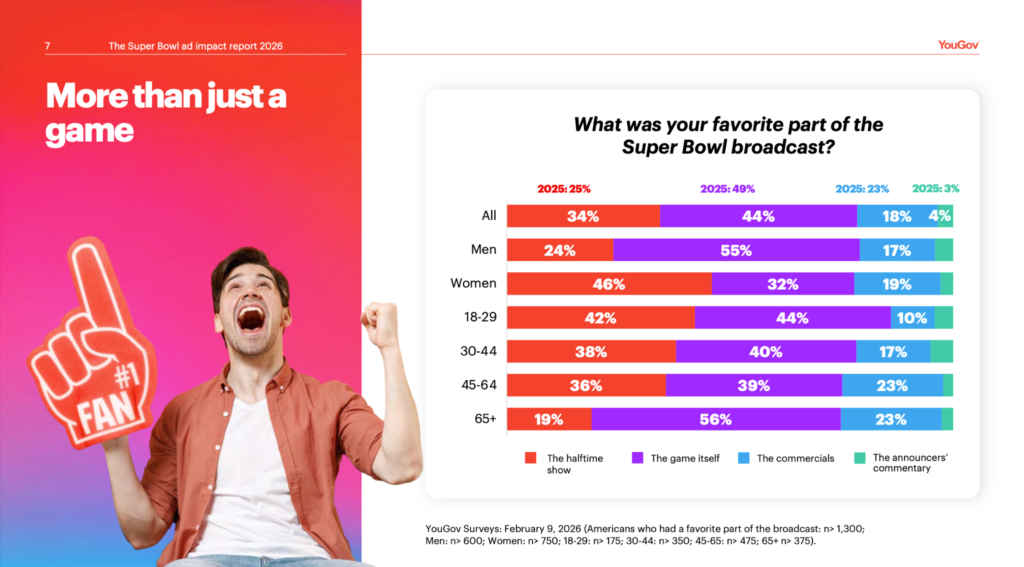
Only 44 percent of viewers said the game was their favorite part of the broadcast, down from 49 percent the previous year. Thirty-four percent said the halftime show was their favorite, up from 29 percent. Commercials ranked third at 18 percent.
In other words, the Super Bowl is no longer a singular sports event. It is layered entertainment competing for attention inside its own broadcast.
Fifty-seven percent of U.S. adults reported watching at least some portion of the game, slightly down from 59 percent the year prior. Younger viewers were more likely to watch in fragments rather than from kickoff to final whistle.
That context matters when a brand invests seven to eight million dollars in thirty seconds.
Celebrity-driven spots did exactly what they were designed to do. They drove recall. Nostalgia triggered emotional response. In some cases, emotional storytelling meaningfully increased trust metrics.
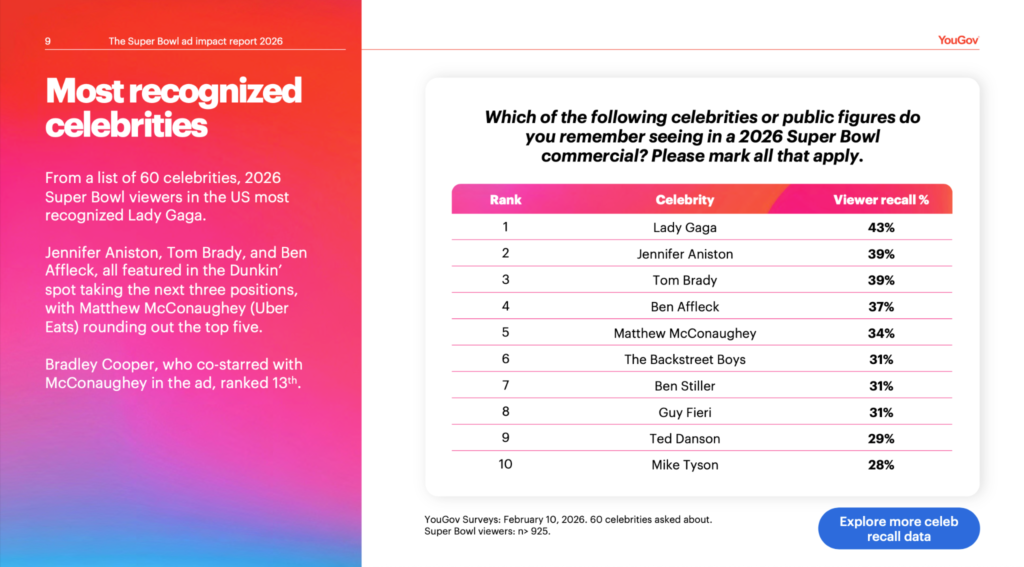
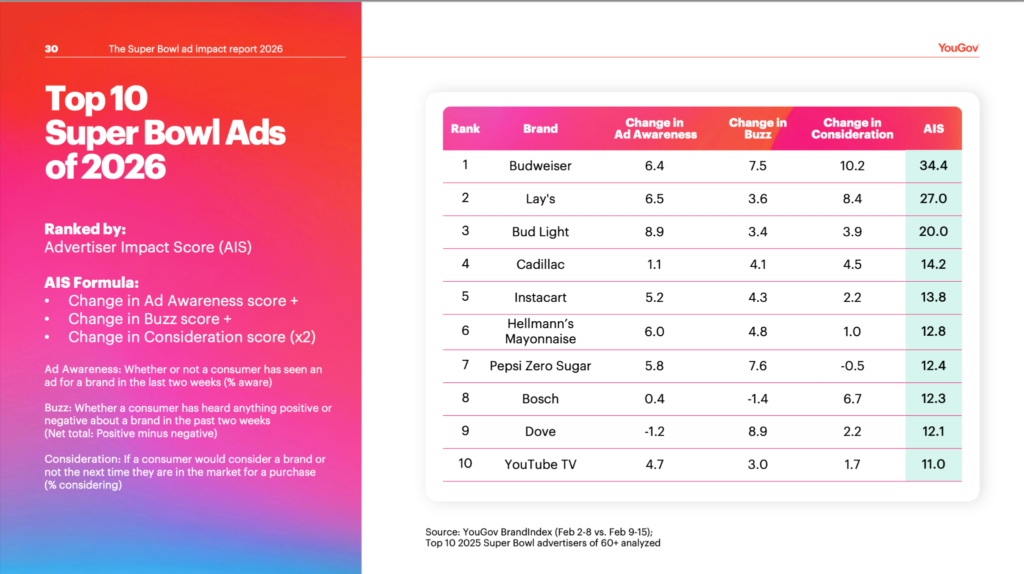
But YouGov’s Advertiser Impact Score tells a more complete story.
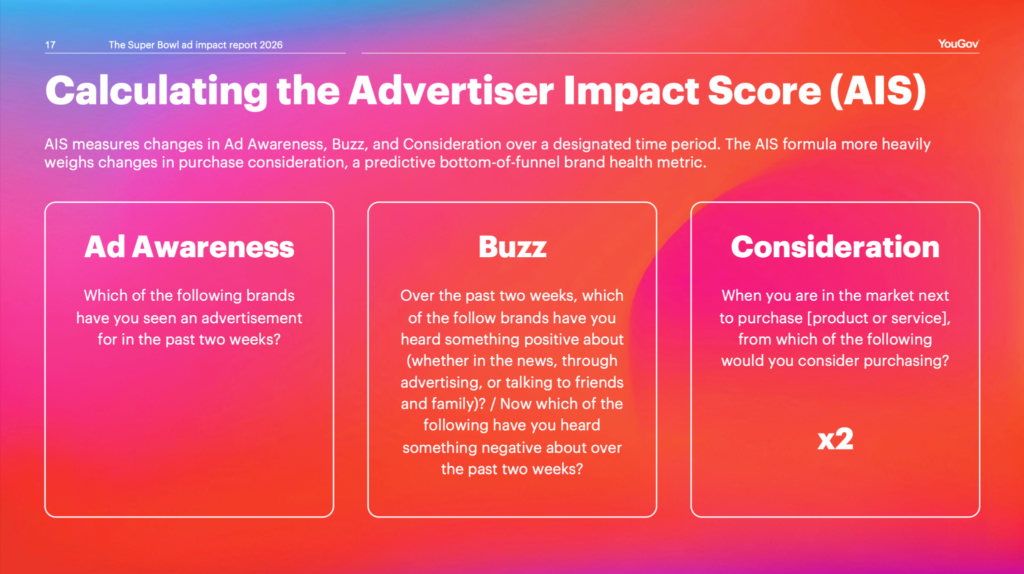
The score combines ad awareness, buzz, and consideration, with consideration weighted double because it reflects forward-looking purchase intent.
That weighting matters.
Because not every ad that generated buzz generated lift.
Coinbase is a clear example. About a quarter of viewers recalled seeing the ad during the game, yet nearly 70 percent of respondents said it was not very likely people would remember the ad was for Coinbase. More notably, 32 percent reported being less likely to use Coinbase after seeing it, compared to only 9 percent who said they were more likely.
Awareness was there. Brand anchoring was not.
Dunkin saw strong awareness and buzz metrics rise, yet consideration declined. When consideration carries greater weight in scoring, that decline becomes decisive.
By contrast, brands like Budweiser and Lay’s translated emotional resonance into stronger brand association and positive movement. Budweiser, for example, appeared in the top five among both men and women and generated strong emotional response tied closely to brand identity.
The pattern is clear.
Attention is concentrated. Preference is built.
A single exposure, even at Super Bowl scale, opens the door. Without reinforcement, that impact decays quickly.
The spike is immediate. The drop-off is structural.
Which leads to the strategic question: if the Super Bowl is the Hail Mary, what sustains the Drive?
The Lifecycle Extends Beyond the Broadcast
The answer starts with behavior.
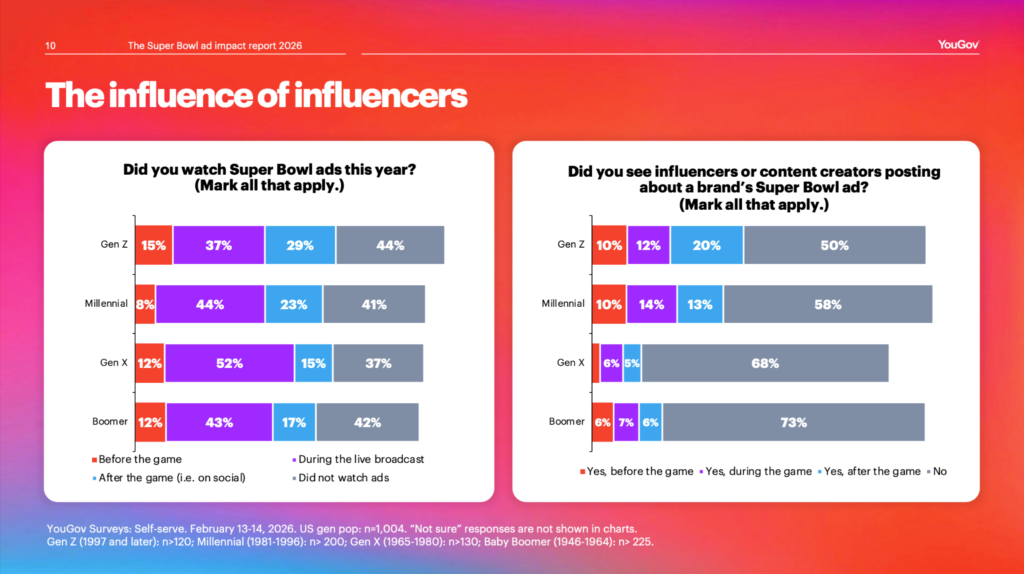
Gen Z respondents were significantly more likely than older audiences to report seeing Super Bowl ads after the game on social platforms. In fact, nearly as many Gen Z viewers encountered ads post-game in feed as during the live broadcast itself. Gen X and Boomers were the least likely to see ads before or after the game through social channels.
This is not a small distribution nuance. It changes the lifecycle of the campaign.
For younger audiences, the Super Bowl is not confined to a three-hour window. It becomes a content cycle. Ads are clipped, reposted, reacted to, and reframed. The moment stretches across feeds for days.
If a brand’s strategy ends when the broadcast ends, it is aligned to one segment of the audience and misaligned to another.
That is not a creative issue. It is structural.
Creators Extend and Interpret
The data reinforces this.
Younger audiences were far more likely to report seeing influencers or content creators post about Super Bowl ads, largely after the game.
Influencers were not the dominant casting choice this year. They were not the headline.
But they are increasingly part of how Super Bowl advertising travels and how it is interpreted.
Creators act as cultural translators. They react to ads, critique them, parody them, and embed them into everyday content. That translation layer extends the lifespan of a thirty-second spot inside trusted communities.
Importantly, even Gen Z did not overwhelmingly say influencers should appear in Super Bowl
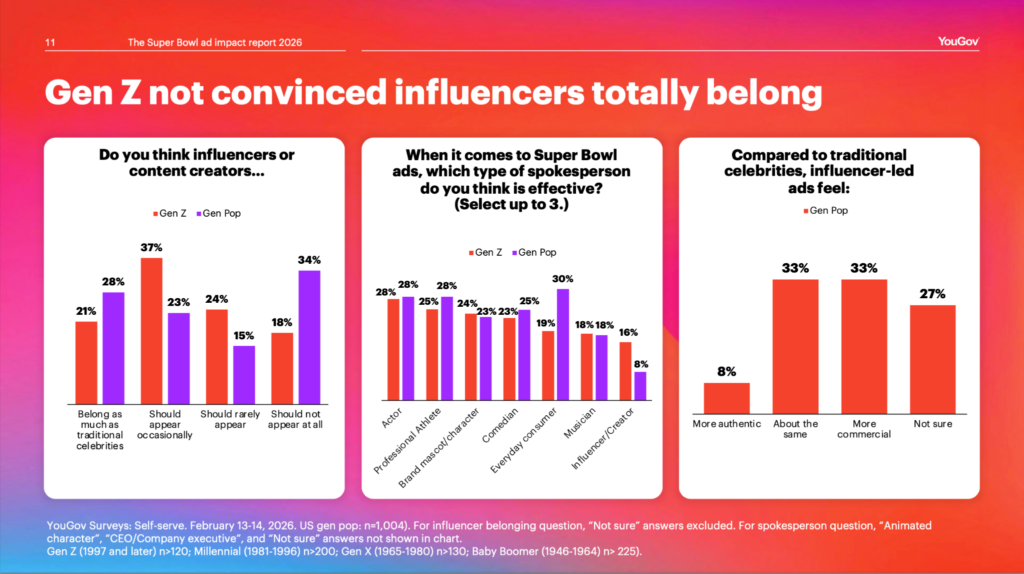
Audiences are not asking for influencers to become thirty-second spokespersons. They are responding to creators where credibility remains intact, through repetition and proximity.
Celebrity creates scale in a moment.
Creators create reinforcement over time.
The Hail Mary generates the spark.
The Drive builds the system.
What a Structured Drive Looks Like
The contrast becomes clearer when you look beyond the broadcast model.
In a recent multi-market creator campaign, a brand invested approximately 1.2 million dollars and generated 161 million impressions across 90 trusted creators, producing nearly 500 pieces of content over several months. Rather than relying on a single burst of attention, the campaign was built as a compounding creator flywheel, where awareness, engagement, and credibility reinforces once another over time. That structure created distributed momentum, with audiences encountering the brand repeatedly in trusted environments and giving consideration the time and reinforcement it needs to take hold.
Seven to eight million dollars buys a moment.
One to 1.2 million dollars can build a system.
The Super Bowl is ignition. It creates cultural energy at scale.
Influence is infrastructure. It sustains that energy and compounds it.
The Hail Mary makes the play visible.
The Drive determines whether it converts.
Moments generate impressions. Sustained influence generates momentum.
And momentum is what builds brands long after the final whistle.