
Key Takeaways
Most CMOs struggle to defend influencer marketing ROI because their measurement relies on attribution, incomplete cost accounting, or unclear campaign objectives.
Programs that scale past $2M fix this by doing three things differently:
- Measuring incremental revenue, not attribution proximity
- Separating revenue ROI from brand ROI instead of forcing both into the same metric
- Auditing their program rigorously and reallocating spend toward what actually performs
The gap between “we think this is working” and “here is exactly what it generates and how we are optimizing it” is where influencer marketing becomes a scalable growth channel.
Your enterprise influencer program is performing. Creators are producing content that resonates with audiences, and the pipeline reflects that momentum.
Yet, somewhere between realizing “this channel is doing something” and demanding “this must be a funded growth engine at $10M+,” the mathematics begin to wobble. Cross-channel cost lines blur. Standard attribution models quietly inflate the results.
Enterprise influencer marketing campaigns that scale past $2M fix this by doing three things differently:
- Measuring incremental revenue, not attribution proximity.
- Separating revenue ROI from brand ROI instead of forcing both into the same metric.
- Auditing their program rigorously and reallocating spend toward what actually performs.
The gap between “we think this is working” and “here’s exactly what it’s doing and what we’re doing next” is where influencer marketing becomes a scalable growth channel.
Here is how enterprise marketing leaders build a framework to measure influencer marketing ROI that withstands boardroom scrutiny.
The Influencer Marketing ROI Formula: Moving Past the Dashboard
How can a business assess the ROI from influencer marketing when standard tracking ecosystems fail to capture social and cross-device conversions?
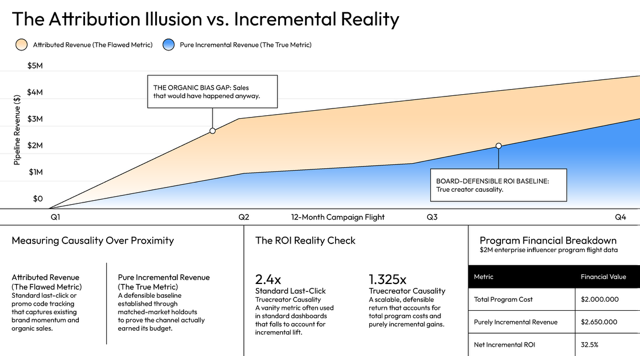
Most internal teams still treat influencer marketing ROI like a glorified dashboard metric. The standard influencer marketing revenue calculation typically looks like this:
Standard Influencer ROI = Attributed Revenue ÷ Total Program Cost
The equation appears clean, but it breaks once ROI of influencer marketing is evaluated against incremental lift. Attribution can indicate who was in the room when the conversion happened. Usually, it rewards the last click. It cannot definitively prove who actually drove the purchasing decision.
For enterprise budget allocations, our methodology at The Shelf requires a sharper, more unforgiving lens:
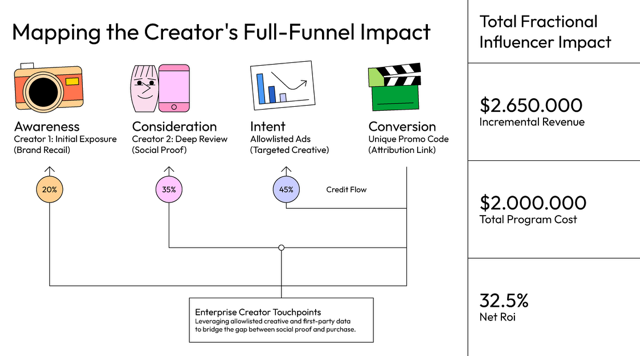
Net Influencer ROI = (Incremental Revenue – Total Program Cost) ÷ Total Program Cost
Applied to a mid-market $2M program flight, the financial reality becomes undeniable:
- Creator fees and licensing: $900K
- Production, ops, tech, compliance: $1.1M
- Total program cost: $2M
- Purely incremental revenue: $2.65M
- Net ROI: 32.5%
Every operational cost is accounted for. The revenue is purely incremental. The methodology fits into a single, defensible sentence: “We measure what would have happened without the creator layer, then use that exact gap as our revenue baseline.”
Incremental vs. Attributed: The Line That Cannot Blur
Attribution shows where a conversion happened. Incrementality shows what actually caused it.
When marketing leaders need to demonstrate the value of influencer marketing to the board of directors, incrementality is the only metric that determines whether the channel earns continued investment. It decides if influencer marketing gets $2M, $5M, or $10M next year.
You do not need a 40-slide methodology appendix. You need a clear stance. The marketing department must judge its creator programs strictly on the revenue that disappears when the spending stops.
This marks a critical strategic shift. You move from stating “the creator helped” to proving “the channel earned its budget.”
The Matched-Market Holdout Test
To isolate this incrementality, enterprise brands must move beyond promo codes.
At The Shelf, we utilize advanced geo-testing and holdout methodologies. By isolating two statistically identical geographic markets: running the creator program in Market A while keeping Market B completely dark; we isolate the exact percentage of sales lift generated solely by the creator content. This completely neutralizes organic sales spikes and removes the bias of existing brand momentum.
Audit the Program Like a Board Presentation
Before requesting any additional budget, an internal audit is essential. Not because something is broken, but because the marketing leaders who successfully scale influencer programs understand their economics in detail. They can identify where performance is strongest, explain how budget is allocated, and show exactly where the ROI and value of influencer marketing comes from before anyone asks.
When analyzing ROI from influencer marketing, look for these three operational leaks:
1. Spend Transparency and Production Bloat
Break down the $2M budget allocation. Do not stop at surface-level creator fees.
- Include every hidden line item. Factor in manual creator discovery, legal compliance, and internal labor hours.
- Know the exact budget allocation by tier (micro, macro, mega).
- Enforce rate cards rigorously using historical market intelligence, rather than accepting premium pricing based solely on follower counts.
- Identify the bottom 20% of performers.
If the reason those creators remain active is simply that the team has not had time to review performance, the influencer marketing ROI calculation is effectively a guess..
This is why our Creator-Led Production Engine is designed to apply institutional memory to production. We preserve creative intelligence while systematically eliminating process bloat.
2. Measurement Rigor
Ad fraud and inflated follower metrics directly destroy your influencer marketing ROI. They inflate your cost basis with zero mathematical chance of impacting your revenue.
- Identify the precise methodology used to calculate incremental revenue.
- Stress-test it against traditional paid social metrics.
- Utilize ML-powered risk detection. Filter out inorganic engagement before a single dollar is deployed.
3. Optimization Evidence
Demonstrate one strategic move that improved returns over the last 90 days without adding net-new spend.
- Identify the highest-performing creator tier. Ensure the financial allocation reflects that reality.
- Address misaligned budgets. If micro-creators drive a 2.2x return and the budget remains heavily weighted toward mega-creators at 0.8x, the program is inefficient.
- Establish ruthless kill criteria based on 15-day performance windows. Prevent wasted spend on underperforming assets.
Brand ROI vs Performance ROI: Strategy vs Weakness
This is where many enterprise marketing teams unintentionally create their own problem when measuring influencer marketing ROI. A brand campaign is launched to increase awareness or consideration, but it is later evaluated using immediate revenue metrics. The campaign may perform exactly as intended, yet when short-term ROI appears flat, leadership begins asking questions and the CMO is asked to justify the investment.
Measuring both brand and performance campaigns with the same yardstick is a fundamental error in how to track influencer marketing ROI. The strategic maneuver is to own the narrative architecture upfront. Align expectations with pipeline realities.
A mature enterprise portfolio breaks down like this:
- 40% Performance: Targeting a direct 2.0x return in 90 days.
- 35% Brand: Expecting a 15-20% lift in consideration and deal velocity within 90 days, with revenue impact at six months.
- 25% Experimental: Mapping the Interest Graph to find new consumer cohorts before scaling spend.
When a brand campaign generates zero direct conversions in month one, you are not scrambling to explain it. You are on plan.
Brand ROI is Measured in Pipeline Behavior
To accurately measure success of influencer marketing at the brand level, defend the campaigns with leading indicator business outcomes. Do not rely on trailing engagement metrics.
- Consideration Lift: Track this via structured brand lift studies. Enterprise programs leveraging proprietary matching typically see 8-18% lifts in brand recall.
- Deal Velocity: Do conversions happen faster? Influenced opportunities consistently close 15-30% faster than cold pipelines. The prospect has already been primed by a trusted, third-party voice.
- Paid Social Efficiency (The Halo Effect): Creator content consistently outperforms brand-shot creative. When creator assets are allowlisted into paid social channels, enterprise brands typically observe a 20-30% reduction in blended Customer Acquisition Cost (CAC).
These are not vanity metrics. They are mathematical proofs that the channel fundamentally changes downstream unit economics.
Optimize Influencer Marketing ROI Without Adding a Dollar
Once your baseline ROI of influencer marketing is established, optimization should shift from subjective guesswork to systematic execution.
At The Shelf, we run campaigns through our Optimization Flywheel, a continuous performance system that turns creator data into actionable insights. SpliceLab™ powers the creative testing layer within that system, allowing us to refine and amplify the highest-performing content.
Here is exactly how enterprise programs scale their returns step-by-step.
Level 1: Performance Pruning (+5-15% Lift)
Early performance data often reveals a group of creators whose content consistently underperforms.
- Reallocate budget away from consistently underperforming creators.
- Shift that spend toward the top-performing creators and content formats.
- Apply rate cards based on performance data rather than follower counts or perceived influence.
Most enterprise programs bleed 15-20% of their annual budget on creators who should have been removed in month two. This level is simply about closing the tap.
Timeline: 60 days.
Result: 1.2x → 1.3x return on identical spend.
Level 2: Portfolio Optimization (+10-25% Lift)
Shift budget toward creator tiers that historically drive the strongest engagement and revenue signals..
- Structure the program using a barbell portfolio.
- Allocate roughly 60% of spend to always-on creator programs.
- Allocate the remaining 40% to campaign bursts around seasonal or promotional moments.
- Continuously evaluate performance signals to reallocate spend toward stronger creators.
This preserves the budget before it is exhausted on underperforming assets. This isn’t about working harder. It’s refusing to fund what doesn’t work and doubling down on what does.
Timeline: 120 days.
Result: 1.3x → 1.5x return on identical spend.
Level 3: Measurement Infrastructure (+20-40% Visibility Lift)
Influencer marketing measurement infrastructure determines how clearly performance can be evaluated.
- Implement standardized UTM tracking across all creator links.
- Deploy unique promo codes and attribution signals.
- Integrate creator performance data into CRM and analytics systems.
Marketing leadership must know exactly which creators are lowering blended CAC by 15-20%. At this stage, creative performance is evaluated alongside measurable business outcomes.
This doesn’t change the ROI directly. It changes how clearly you see it, which sharpens every decision you make afterward.
Timeline: 90 days.
Result: 30% clearer view of pipeline impact.
Level 4: Interest Graph Targeting (+12-30% Lift)
The final stage moves beyond the traditional social graph. Follower relationships matter less than audience interests and behavioral signals. What audiences actually care about is everything.
Use interest-driven data to map creator audiences to your ideal customer profile (ICP).
- Prioritize creators whose audiences demonstrate the strongest behavioral alignment with high-value customers.
- Systematically cut audience overlap.
- Target niche interest cohorts.
By executing this, programs operate with 30% fewer creators, maintain total effective reach, and aggressively lower acquisition costs.
You are no longer buying reach. You are buying exclusive access to the exact cohorts that convert at the highest rates.
Timeline: 180 days.
Result: 1.6x → 1.9x return on identical spend.
Command the Data, Command the Budget
Most CMOs can sense when influencer marketing is working. The ones who actually scale it rely on measurement instinct.
They calculate influencer program ROI the same way the rest of the business evaluates investment: on incremental revenue, not attribution models. They audit their programs with the expectation that the numbers will be scrutinized. They evaluate brand campaigns on appropriate timelines, rather than expecting immediate revenue signals. And they optimize by reallocating budget away from underperforming creators and toward those that drive results.
Programs that remain at $2M and those that scale toward $10M often run very similar campaigns. The difference is operational clarity. One CMO can walk into a room and explain every number, defend every decision, and outline the next move with confidence.
That level of command is what earns continued investment. Building that command requires a purpose-built infrastructure.
At The Shelf, we engineer influencer marketing for enterprise predictability. We replace attribution guesswork with defensible measurement. Through our Optimization Flywheel, SpliceLab™ creative testing, and Interest-Driven Market Intelligence, we help brands isolate incremental revenue, reduce operational inefficiencies, and improve program performance over time.If you want to move from estimating influencer marketing ROI to defending it with confidence, the first step is understanding your current baseline. Schedule a strategy call with our team to assess your program and identify the next stage of ROI improvement.